Inlägg

My Emissions for 2022 and Our Electricity Production

Bild
Two years has passed since my last annual update... This year, a lot of my focus has been escalation of the unjustifiable war against Ukraine.  Even if Sweden is not directly involved in the battles of the war, the aggressor has made explicit demands that Sweden (along with Finland, Moldova, Ukraine and several NATO and EU members) shall be subjugated to the aggressor. We are all affected by this war and we must do everything needed to help Ukraine stop the aggressions and make Europe a continent under the rule of law again.  My reaction to the war has focused on four areas: Energy efficiency - This year, I'm not the only one to be obsessed with energy efficiency. I have been reducing my electricity consumption to offload the power grid and to prevent blackouts. More about that below. Supporting refugees - I have re-joined a volunteer group in my area, that is giving support to refugees from Ukraine and other countries. I've also been a team leader in that group. Financial sup...

How Much CO2e per kWh?

Bild
 After 16 months, our solar plant has generated 18 000 kWh of electricity. I expect the savings to be more than €3 000 for 2022. As I'm obsessed with global heating and avoiding CO2e emissions, I'm interested in how much CO2e we have avoided. Let's dig into the numbers: According to Sungrow - 1 kg CO2e per kWh The Inverter producer (Sungrow) compares the electricity generation with coal-burning electricity. Combining 1 kg Coal gives ~3.7 kg carbon dioxide and gives up to 9 kWh. If the thermic energy is converted to electricity with 33% efficiency, one kWh will generate 1.2 kg CO2e.  That would cancel the emissions from my entire family's personal consumption, if that number would reflect our savings. But it doesn't. Averaging to the Swedish Electricity Mix ~13 g CO2e per kWh Luckily, the electricity production in Sweden is almost coal-free. Most of the electricity is generated from wind and water, and also extracted from nuclear nucular  power. What is the CO2e cos...

Solceller för villa - viktigt att tänka på

Bild
Under sommaren installerade vi en solcellsanläggning i samband med en totalentreprenad. Anläggningen ger effekt som planerat, men en besiktning visade allvarliga brister i installationen. Efter sex månader av animerade diskussioner fick vi firman att rätta till anmärkningarna.  Avståndet i höjdled mellan solcellerna är nu en centimeter. Jag listar de tips som jag hade haft nytta av i denna post. Offert - innan ni skriver på Viktigast av allt är att förklara för solcellsfirman att detta inte är ett hobbyprojekt utan en starkströmsanläggning som monteras på ert hem - det måste göras enligt regler och anvisningar.  Solcellsfirman bör vara medlem i branchorganisationer som t ex Svensk Solenergi . Solcellsfirman ska vara listad hos Elsäkerhetsverket för Elproduktionsanläggningar (Lågspänning). Om företaget installerar på sin egna anläggning behöver de inte vara listade men då måste de ha egenkontrollprogram. Ring Elsäkerhetsverket om du har minsta frågetecken om Solcellsfirmans beh...

Stupid Incentives for Small Electricity Consumers/Producers

Bild
As a home and solar cell owner, I've seen two stupid incentives that will encourage some to waste electricity and encourage some other to turn off their solar systems. I'm not complaining about my electricity bill, the last one happened to be very low. Why It Is Sometimes a Good Idea to Turn Off Swedish Solar Systems Some Swedish houses with solar panels have only covered a part of the roof . Some other house owners turn them off during fall , or choose to waste energy the last months of the year. Why? They fear they will produce too much electricity, and doing so can be expensive. As a residential solar power owner, it is important not to produce more electricity than you consume. If that is the case, I qualify as a microproducer , and I don't need to pay Input Fees ( Inmatningsavgifter ) to the grid owner. If I have a surplus, the grid owner may charge me, and that may cost thousands of Swedish kronor. Fortunately, it seems that not all companies do so. This could easily ...

Batteries for Our Solar Power System

Bild
We have had a major renovation of the roof, with an installation of a 40-panel Solar Power system. There are still some corrections to be done by the installation company later this fall. We expect to convert some 13 MWh of solar energy to electricity per year. Some of my friends have asked me if I plan to save the energy for later usage. The short answer is "no - too expensive and too little storage capacity". Generally, it is cheaper to sell electricity to the power grid and buy when needed. Let's explore what it would mean to save energy and sell when it is more expensive: Normally, the productive hours are between 10:00 and 16:00. On a particular day (2021-09-16),  the price fell to 1.35 SEK/kWh at 2 PM. If I stored 10 kWh (13.5 SEK) at that time, I would have 9 kWh in the battery, assuming 10% heat loss for the battery. Later that evening, the price increased to 1.95 SEK per kWh. When selling that energy to the grid, I would get 17.55 SEK. That would make me 4 SEK.  ...

My Emissions in 2020

As I predicted, I increased my personal CO2e emissions this year to 3.8 tonnes.  This is mainly due to the relocation of me and my family to a house in Åkarp outside Malmö. We bought quite a lot of furniture, tools and services during the year. The pandemic reduced our travels and consumption, so this year wasn't as dirty as I feared. I compare my personal emissions with the average personal emissions in Sweden: In 2018, I emitted 4.7 tonnes, on par with the average of 4.8 tonnes. (98%) In 2019, I emitted 2.9 tonnes. The data from SCB isn't available yet, but if I extrapolate the falling trend, the average would be 4.6 tonnes. (~63%) In 2019, I emitted 3.8 tonnes. The data from SCB isn't available yet, but extrapolated values together with a pandemic makes a very rough guess at 4 tonnes (95%). It is clear that there will be some restrictions in 2021, so I expect to have quite low emissions this year. However, my family has relatives abroad, so there is some likelihood for l...

Emissions of the Lowest Acceptable Standard of Living

Bild
It is clear that our consumption leads to irreversible harm to our world. In this blog post I'll estimate the emissions for a person that lives on subsistence. Merriam-Webster defines subsistence as Another definition would be: The lowest standard of living any human being should have. For Sweden, I've found two sources: The Enforcement Agency (Kronofogden) and The National Board for Health and Welfare (Socialstyrelsen). For simplicity, I'll follow the calculator from Socialstyrelsen that indicates whether one can qualify for subsidence support. The subsistence consists of two parts: Personal expenses for the individual, for example food and clothes. Shared common expenses for the household, for example utility bills and newspapers. I'll calculate the levels for a single adult. Living: The guideline from Socialstyrelsen is one bedroom, one kitchen and one livingroom - roughly 60 square meters. Electricity 1500 kWh per year Monthly Personal Expenses...

5G: All The Light We Can't See

Bild
I've seen some posts in my circles about concernds for 5G and negative health effects. In this blog post, I'll discuss some basic Radiation Physics and why I'm not worried about health effects from electromagnetic radiation in the frequency bands that will be used by 5G. Disclaimer: I'm working in the 5G industry. This means that I'm familiar with the radio technology and some of the standards of 5G. I also own stocks in ERICSSON B. Excecutive Summary: 5G is most likely safe. The frequencies that 5G will use are far below the dangeerous (Ionizing Radiation) frequencies. As long as one stays more than ten meters away from a base station, the total energy absorbed (heat) will be below the ICNIRP recommendations.- According to WHO, no harmful effects of wireless communications has been found. Lights from lamps will deliver more energy to you, with much more energetic photons. They are safe, too. Light from the sun will have much higher power and photon...

My New Years Resolution for 2019 - and No One for 2020

Promise One year ago, I promised to reduce my personal consumption based CO2e emissions from 4.7 tonnes to 3.8 tonnes. Result In 2019, my personal consumption based CO2e emissions was 2.9 tonnes - a reduction of 1.8 tonnes. Together with the public emissions of 3.8 tonnes, that gives a total of 6.6 tonnes of CO2e. I've honored my NYE resolution but my emission levels are far from sustainable. The average in Sweden is some 6 tonnes of personal consumption based CO2e emissions, so I'm a bit below the average but still higher than the one tonne target from IPCC. My emission levels are not OK! However, I've reached the conclusion that this issue is larger than the sum of individuals and their actions. While some individuals stop flying, others keep flying and governments build new airports and expand existing ones. Individuals buy electric bikes, while governments builds pipelines and can't decide whether to expand oil refineries or not. Get me right - the con...

New Home, New Focus

Bild
I've been busy with our next home - papers are signed and relocation will happen next spring. The impact for this blog will be a slight shift of focus on this blog. I'll still have some discussions about resources on a macro and micro scale but I'll also investigate how to approach a sustainable life in suburbia. I won't move far though. We'll move to a community between Lund and Malmö, 8 km from our current home. During the summer, I've helped out with reviewing some sources for a publication by Extinction Rebellion that is distributed to political leaders around Sweden. I have reached the conclusion that reducing my own emissions won't be enough to stop the ongoing global heating. I need to speak louder and I'm grateful for the opportunity to help XR with the publication. I'll elaborate more on my thoughts in the next blog post. Side note:  My current prediction is 2.3 tonnes of CO2e of personal consumption based emissions for 2019. To...

You, a Sheep, an Otter and a Hare

Bild
I saw one infographic about the biomass of humans in relation to the wild and domesticated mammals. Note that the wild animals (mammals) include both marine mammals and land mammals. I couldn't believe that graph - do we outweigh all the wild lions, monkeys, bears, kangaroos, mice, elephants ... by a factor 9:1? The quoted  article  estimates the biomass in terms of GtC (billions of tonnes of carbon. A human being has roughly 8 kg of carbon (and ~60 kg of other elements) and mankind has a total biomass of 6 GtC, for example. See also the book The Earth's Biosphere: Evolution, Dynamics and Change  (I need to confess, that I haven't read that book). https://xkcd.com/1338/ The total biomass for humans outweigh the wild mammals by a factor 9:1. What does this mean for us? Let's return to the small island that I discussed before , where the land area of the world is divided evenly between all humans. You'll find it slightly smaller but don't worry a...

Climate: Putting My Money Where My Mouth Is

Bild
Summary : The idea behind offsetting carbon emissions is to pay someone else to reduce his/her emissions and to relate that reduction to ones own emissions. It can be a good thing - or a bad thing.  If the purpose is to keep polluting with a green-washed conscience, it is a bad thing.  If the purpose is to reduce your own pollution and help others to reduce theirs, it is a good thing. There are some ways to offset carbon as an individual. Some are credible and others seems to be scams and green-washing.  In this blog post, I'm trying to learn more about offsetting, when to use it and how to do it. Ester hoped that her younger cousin Grace would fall a sleep early this evening - in vain. Three days before the last year project in Chemistry was due and a "B" in STEM wasn't an option. Now, Grace was occupied with a jigsaw puzzle and Ester was able to focus on her project. The smell of kerosene from the lamp was a bit ironic - Ester's project was focusing...

Oil, Blood, Sweat and Tears

Bild
30-second summary: We emitted more CO2e than ever in 2018.  Heat waves in Europe with higher temperatures than the disastrous heat wave in 2003.  Heat wave and severe water shortage in India that will worsen the coming years.  Heat waves are predicted results of global heating. The Strait of Hormuz is essential for oil supply. Anyone who controls it will control the world economy. US are deploying troops and amphibious assault ships to that region. Is that a threat or preparations for war against Iran? 660k Swedish Facebook users are opposing high petrol prices. The group has addressed an urban-rural conflict area, and might defer politicians from tackling global heating. When I started this blog, I wanted to avoid discussing current events and focus on slower and more profound changes in the world we live in and the lives we will be able to live. This blog post will be an exception and I will discuss some recent events. Oil - BP's Statistical Review of Global ...

Oil: Orinoco Flow, Dirty Sand and Thirsty Empires

Bild
20 Second Summary: Three out of five of the worlds largest economies (EU, Japan and India) have almost no oil reserves. China are currently importing most of its oil, and USA will need to import most of its oil very soon. The demand of oil is rising and the supply will eventually fall.  I expect price shocks  and shortage of oil and oil-related products. Price shocks for oil will not save the climate - there is enough of oil, natural gas and coal to reach 450 ppm and above.  Peak-oil is a second strong reason to stop wasting our resources and to stop heating our planet. Oil Reserves, Consumption and  Production  Recovery In this post, I will investigate the supply and demand of oil for different regions of the world. I'll start with listing the countries with the biggest  GDP, reserves, production and consumption respectively. GTOE is a billion tonnes of oil equivalents and MTOE is a million of oil equivalent. The five largest  economies ...

Oil: Economy of Oil

Bild
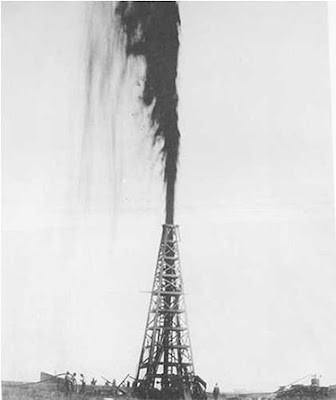
Summary: We will not run out of oil. But we will run out of cheap oil and the oil "production" will drop because of this. It is getting more expensive to extract oil over time and eventually oil will be too expensive to extract. In the last blog post, I discussed how much oil we have, how much "new" oil we find and how much oil we consume. To understand this, it is essential to understand the economy of oil and the theory of peak-oil . Economy of Oil - EROI When one decides whether or not to extract oil from an oil field, one will consider how much effort is needed and how much returns one can expect. The specific energy of crude oil is 11.6 kWh per kg and that is the upper limit of the efforts one would put in to get oil - it would be much more energy efficient to take a nap than to spend 12 kWh of energy to get 11.6 kWh of energy. One of the first towers of the Spindletop oil field in the early 20th century . Initially, it is easy to extract oil (hig...

Energy: Rubberducking Oil

Bild
When I digged into the numbers for this blog post, I found some of my misunderstandings about our relation to oil: Renewable energy is replacing fossile fuels: False Globally, the share of renewables increased by 14% between 2016 and 2017 (an increase of almost 70 Million Tonnes of Oil Equivalents). The global share of fossile fuels decreased slightly from 85,5% to 85,18%. But the total supply of fossile fuels increased by almost 180 MTOe. Fossile fuels is growing more than twice as much as renewables! This is a school-book example of why it is important to distinguish absolute increases from percent-wise increases. Sweden has phased out fossile fuels and is a role model for the world : False. Sweden imports some 10 million tonnes of oil per year - one tonne per person. The global consumption is 4.5 billion tonnes per year -  600 kg per year and person. Nope. Looking at the oil reserves, this is bad news. I'll start discussing why without mentioning Global Warming in th...